
When I was growing up, we owned Michael Jackson’s Thriller on vinyl, on 8-track (yes, I’m that old), and eventually on cassette, so we could blast “Beat It” in my parents’ Monte Carlo while they drove me to school. That was one of my favorite songs in elementary school, although it’s not like I sought it out; it was just there, and that opening guitar riff was impossible to resist. Growing up in the eighties meant growing up with Michael Jackson as a fixed point in the culture, and I think he also represents one of my earliest recognizable examples of what we now call a parasocial relationship: that strange, one-sided intimacy where you feel like you genuinely know someone you’ve never met. The complicated feelings that followed in later years, stemming from the abuse allegations and the subsequent settlements, and more recently the Leaving Neverland documentary and the estate’s scorched-earth response to it, never fully dissolved that early imprint. I don’t go out of my way to listen to Michael Jackson these days, but if “Billie Jean” comes on in a restaurant, I’m probably still humming along before I even realize it.
I mention all of this because it’s relevant context for what Antoine Fuqua’s Michael is, and isn’t, trying to do. Written by John Logan, authorized and shaped by Jackson’s estate (with his siblings and former attorney John Branca among the producers), the film doesn’t seem particularly interested in who Michael Jackson was; rather, it’s interested in preserving the version of him that already lives in your memory. To me, that seems like a pretty meaningful distinction, and largely the reason it ultimately feels like putting on a greatest hits playlist while reading his Wikipedia page.
The film covers Jackson’s life from the Jackson 5’s formation in Gary, Indiana up to the opening of the Bad tour in 1988, with young Michael played by Juliano Krue Valdi and adult Michael by the singer’s real-life nephew, Jaafar Jackson. Let’s deal with Valdi first, because he deserves more credit than he’ll probably get: for my money, his is actually the stronger of the two performances, with an emotional openness that the film never quite recaptures once he ages out of the role.
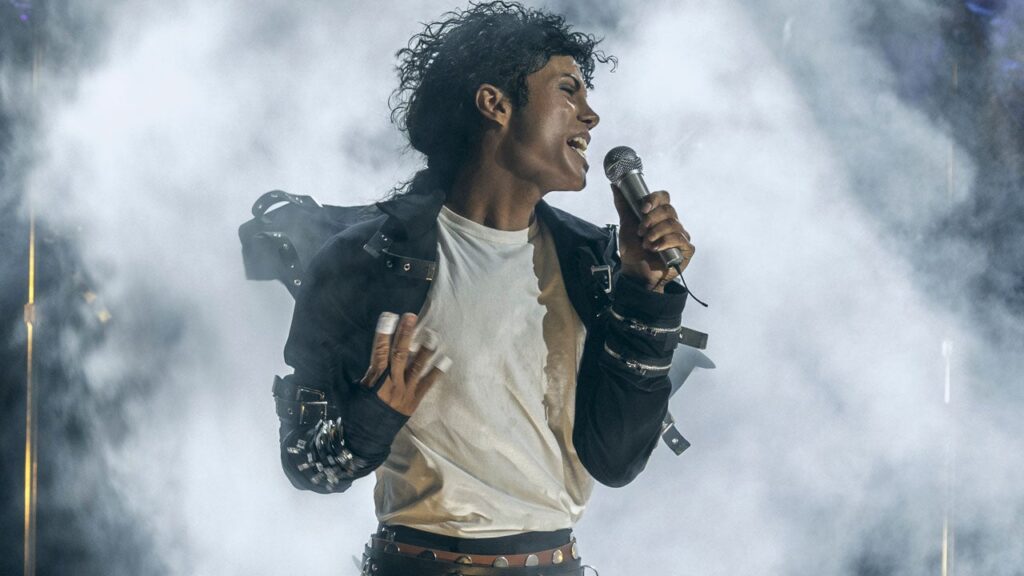
To his credit, Jaafar is genuinely astonishing in the musical sequences as he captures his uncle’s unique physicality: the full-body commitment of those iconic stage performances are recreated with an accuracy that occasionally makes you do a double-take. In those stretches, it’s easy to forget you’re watching a recreation, but whenever Michael is offstage something crucial goes missing. The adult Michael of this film is patient, charitable, whimsical, and essentially without interior life. He loves animals, loves children, loves his mother, and is burdened only by his difficult relationship with his father. That’s not a character; that’s a press release.
Colman Domingo plays Joseph Jackson as the film’s designated villain, and he’s an imposing presence, particularly in the first half. Cold and unloving, he treats his sons’ talent primarily as a financial instrument, and is frequently moment from introducing someone (especially young Michael) to the business end of his belt. Nia Long, a far better actress than the film deserves, is given almost nothing to do as mother Katherine beyond worried glances and gentle reassurances. Which is frustrating, because the brief scenes of Michael and his mother on the couch watching old musicals together hint at a closeness and warmth that might’ve told us something real about him. Instead, those scenes exist as pit stops between milestone recreations, and the film moves on.
At this point, in the Year of Our Lord 2026, the music biopic formula is so thoroughly calcified that complaining about it feels like pissing into the ocean. Michael executes this formula faithfully and without imagination, checking off the requisite boxes and inserting musical numbers whenever the film seems like it might be given a bit of space to breathe. The painkiller dependency that followed the 1984 Pepsi commercial burn accident and would go on to shadow the rest of his life gets a single passing reference, then vanishes. His psychological relationship to children, and to the concept of Neverland (perhaps meant to convey a longing for the childhood he never got to experience) is treated as little more than eccentricity; the film seems to have no interest in examining this in any genuine way.
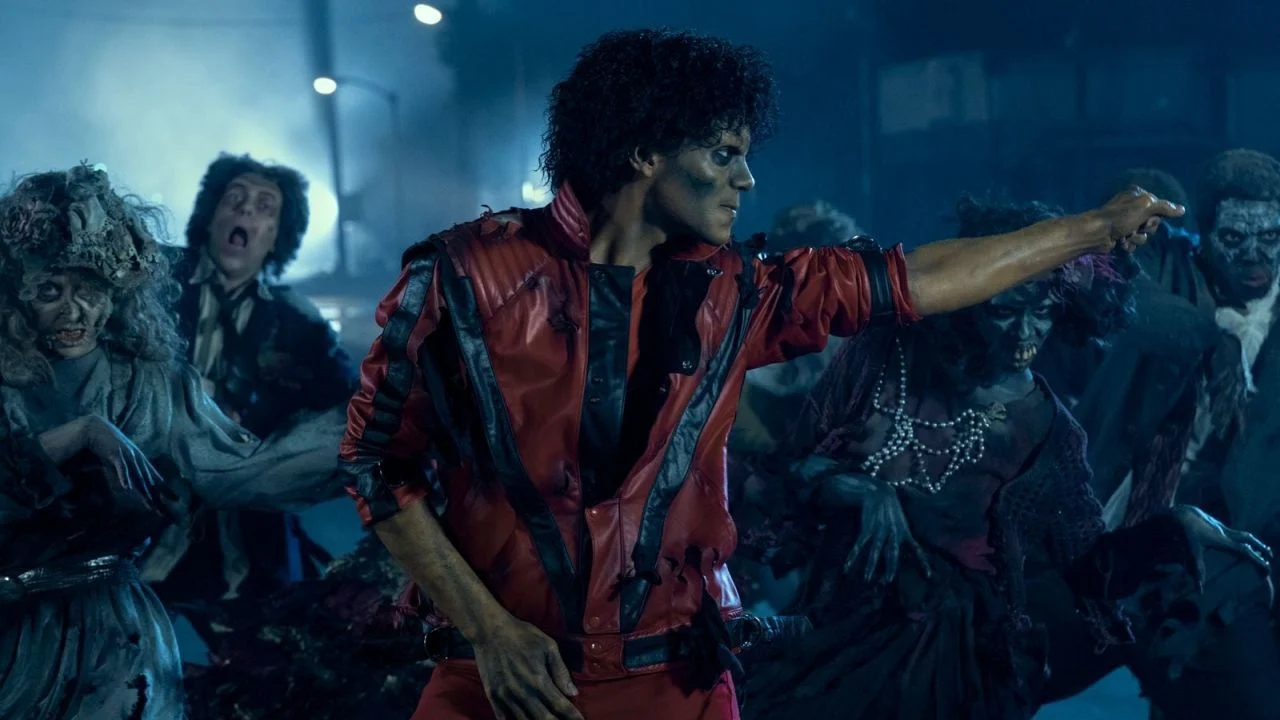
These shortcomings also extend to some of the visual choices. There’s a moment during the filming of the “Thriller” video where Michael the camera operator aside and asks him to widen the shot, to zoom out instead of zooming in. He wants to ensure the audience will be able to see the dancers from head to toe, or risk losing the energy of the performance entirely. It’s a good note, one that a friend and colleague has echoed in recent years for various big-screen musical adaptations, and the fact that Michael literally says this in the film makes it all the more baffling that Fuqua’s own direction often zooms in close during many of the musical sequences, instead of widening the frame.
What distinguishes Michael (at least somewhat) from Bohemian Rhapsody — the obvious comparison, given producer Graham King’s involvement in both — is that it doesn’t seem to actively rewrite documented history the way that film did. Instead, it commits a much larger sin in what it chooses to omit. A Variety report ahead of release revealed that scenes dealing with the sexual abuse allegations against Jackson were removed due to provisions of a legal settlement, taking with them what was apparently the film’s original dramatic framework. You can feel that absence, and this crowd-friendly sanitized version of events rings hollow.
I could go on complaining for a few hundred more words, but the unfortunate truth is this is probably the best that an authorized Michael Jackson biopic was ever going to be. Michael is a film more concerned with the collective public memory of an icon than with the actual human being who generated it. The “his story continues” title card that closes things out at 1988, right before the controversy that defined the latter stage of his life and career, isn’t an ending so much as an escape hatch. It allows the filmmakers to pull up short of anything uncomfortable and ensure viewers walk out with only good vibes.
Here’s the thing, though: it’s likely that none of this will matter at the box office. MJ fans know exactly what they’re getting, they want exactly what they’re getting, and they’ll show up in enormous numbers to get it. If you count yourself among them, Michael will probably be a joyous experience. If you were hoping for something with a little more nerve, or a film actually willing to reckon with one of the most fascinating and troubling figures in pop culture history, you’re probably going to leave the theater feeling the same way I did: like you just watched a very expensive, very polished reminder that the real Michael Jackson is still out there, on YouTube, completely unmediated and considerably more interesting than anything on this screen.