

Growing up, my Robin Hood was a cartoon fox: the 1973 Disney version that a certain subset of animation fans will insist is one of the studio’s lesser entries. I disagree on this point, and continue to treasure that film just as much now as I did when I was renting a VHS copy from my local video store every few weeks. I was also exactly the right age when Robin Hood: Prince of Thieves came out to think Kevin Costner’s inexplicable American accent was completely fine, actually, and while I’ve since made my peace with that film’s abundant ridiculousness, it still holds a place in my heart that good taste probably shouldn’t allow. Throw in a well-worn childhood copy of Howard Pyle’s The Merry Adventures of Robin Hood, and you have some sense of the personal investment I bring to Michael Sarnoski’s The Death of Robin Hood.
The film opens in 1247 A.D. with Hugh Jackman’s Robin: long-haired, bearded, and about as far from the dashing and roguish Errol Flynn as it’s possible to get. He dispatches an aspiring assassin, dropping her body into a field already crowded with previous visitors who arrived with the same idea. The girl’s father, presumably, had a similar fate, and perhaps his father before him. Sarnoski is establishing something in these early minutes that the rest of the film will spend its running time unpacking: that once set in motion, the cycle of violence doesn’t stop, it just keeps finding new inheritors.
That’s the film’s central preoccupation, and it plays out in rather grim fashion. When Robin is approached by Little John (Bill Skarsgård) and drawn into one final, catastrophic confrontation, it’s the same cycle asserting itself again: debts accrued decades ago, being collected by people young enough that Robin can barely remember what he did to earn their hatred in the first place. The resulting carnage leaves him broken and barely breathing at a remote island priory run by Sister Brigid (Jodie Comer), which is where The Death of Robin Hood reveals what it’s truly interested in exploring, which just so happens to have nothing to do with archery tournaments or redistributed wealth.
Sarnoski stages the early violence with a rawness that many will likely find off-putting; indeed, a handful of critics walked out of our screening within the first half hour, and I can’t say I was entirely surprised. But whereas some might consider the brutality gratuitous, I felt it was more a necessity. This is a film about what happens when legend and reality diverge so completely that they become almost unrelated documents. In the opening scene, Robin reveals the truth to his would-be killer: he was a brigand who stole and murdered because he enjoyed it, and the heroic folklore that’s grown up around his name has essentially nothing to do with the man who generated it. “Someone found meaning where there was none,” he tells her, a line that doubles as the film’s thesis statement.
Jackman has long been one of my favorite performers, and I don’t know that he’s ever been better that he is here. I’ll acknowledge the obvious: yes, this invites comparisons to Logan, and those comparisons aren’t unfair: they both deal with an aging hero with a propensity toward savagery, who finds himself compelled to protect someone whose past is inextricably linked to his own. But where Logan functions as a superhero film that happens to have a bit of melancholy, The Death of Robin Hood is considerably less interested in being entertaining on conventional terms. What makes the performance so interesting is the way Jackman plays the violence almost as a reflex, something Robin slips into not because he wants to, but because survival has hardwired it into him over decades. A younger Robin may have found a perverse sort of joy in murder, but in the twilight of his life, this one does it because it’s the only thing he really knows.
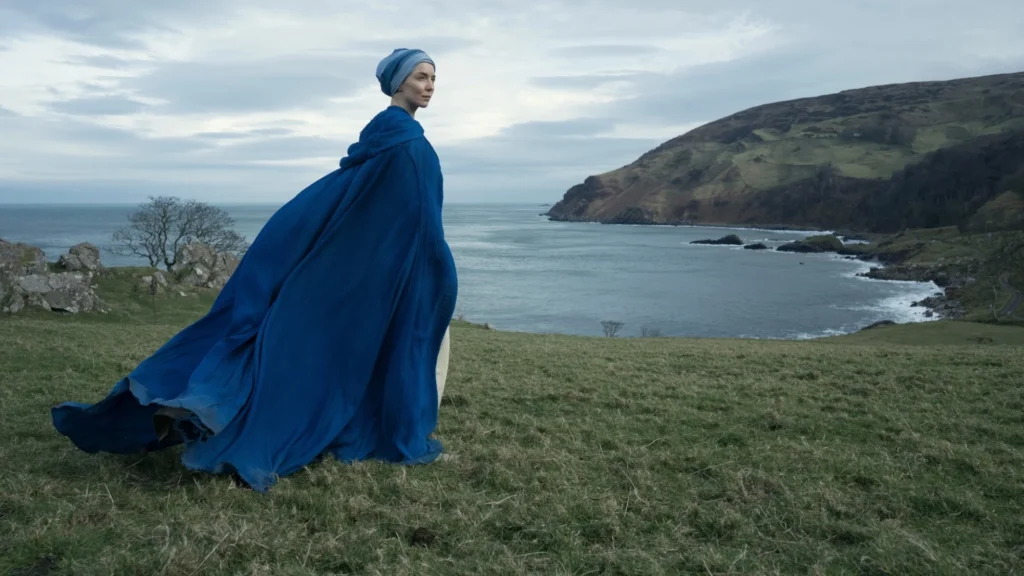
It will come as little surprise that Comer is extraordinary as Sister Brigid. The serenity she projects initially reads as simple goodness, but she’s far shrewder than she lets on: she may not know the identity of the man she’s nursed back to health, but she knows precisely the sort of man he is, and makes her peace with it in ways that gradually establish her as the film’s moral center. The growing bond between Brigid and Robin — more platonic than romantic, although it dances ambiguously around the latter — gradually invites the outlaw to do something meaningful with the final stage of his life, and in trapping food for the island residents or crafting a bow for a young girl, Robin finds a tranquility that has eluded him for nearly his entire life. But the the realization of a decades-old truth and the arrival of a mysterious young stranger (Noah Jupe) both threaten to shatter the fragile peace Robin finds himself clinging to so desperately.
Sarnoski argues that the legend of Robin Hood isn’t a distortion of history so much as a replacement for it: a story people needed badly enough that they built it out of nothing, and kept building long after the man himself was gone. Whether you find that comforting or damning will largely depend on your own personal experiences and biases, and Sarnoski’s film could be interpreted to support either perspective.
The Death of Robin Hood is somber, occasionally punishing, and stubbornly uninterested in giving you a good time, at least in any traditional sense. But it’s also one of the most uncommonly moving films I’ve seen in a while, and easily my favorite of the year so far. I’d recommend it without hesitation.